LSI Lake State Insulation home

Spray foam

Open & closed cell spray foam insulation

Spray foam expands to fill every gap, so one application insulates, air seals and, with closed-cell foam, blocks moisture. We spray open-cell and closed-cell foam in new homes, barndominiums, pole buildings, rim joists and additions across Isanti and the north metro.

  • Open cell and closed cell
  • Barndos, pole buildings and new homes
  • Rim joists, crawl spaces and vaulted ceilings
  • Written estimate after a site visit
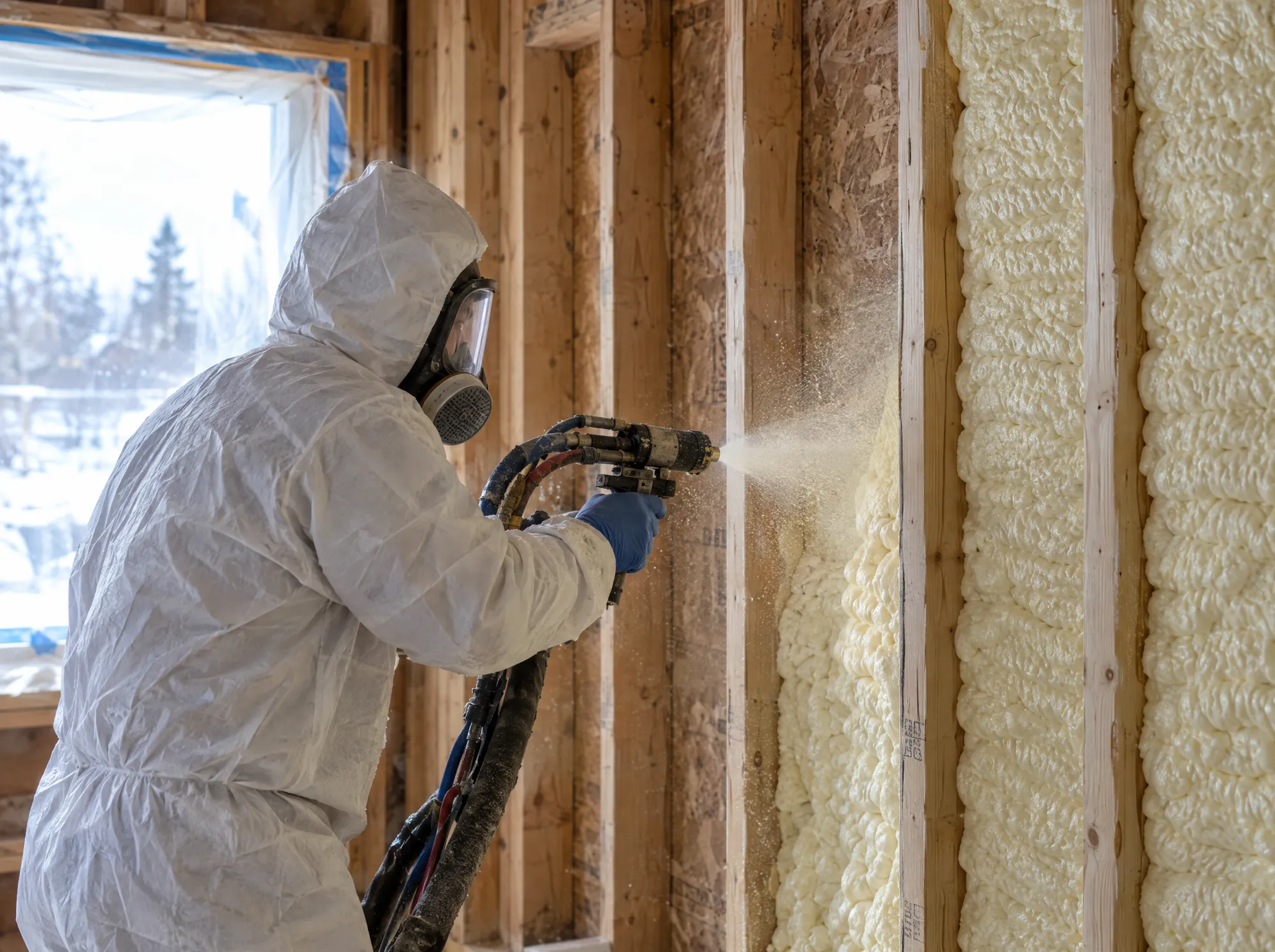
Installer in a respirator spraying closed-cell foam into the stud bays of a new home

How spray foam works

Spray foam starts as two liquids. Our rig heats them and pumps them through a heated hose to the spray gun, where they mix and expand into foam within seconds. It bonds to wood, steel and concrete, and it fills the cracks, seams and odd-shaped cavities that batts and loose-fill leave open.

That is the real advantage over traditional insulation: air sealing and insulation happen in the same pass. Most heat loss in a Minnesota winter comes from air leaking through gaps, not just from thin insulation, and foam closes those gaps as it goes on.
Closed-cell spray foam

Closed-cell foam is dense and rigid, at roughly 2 pounds per cubic foot, and delivers about R-6 to R-7 per inch, depending on the product. At around 1 to 2 inches (again depending on the product) it also works as a vapor retarder, and it stiffens the walls and roof deck it is sprayed on.

It is our go-to on steel-sided barndominiums and pole buildings, where it stops condensation right at the panel, and anywhere space is tight: rim joists, cathedral ceilings, basement walls and 2x4 walls that need a higher R-value.

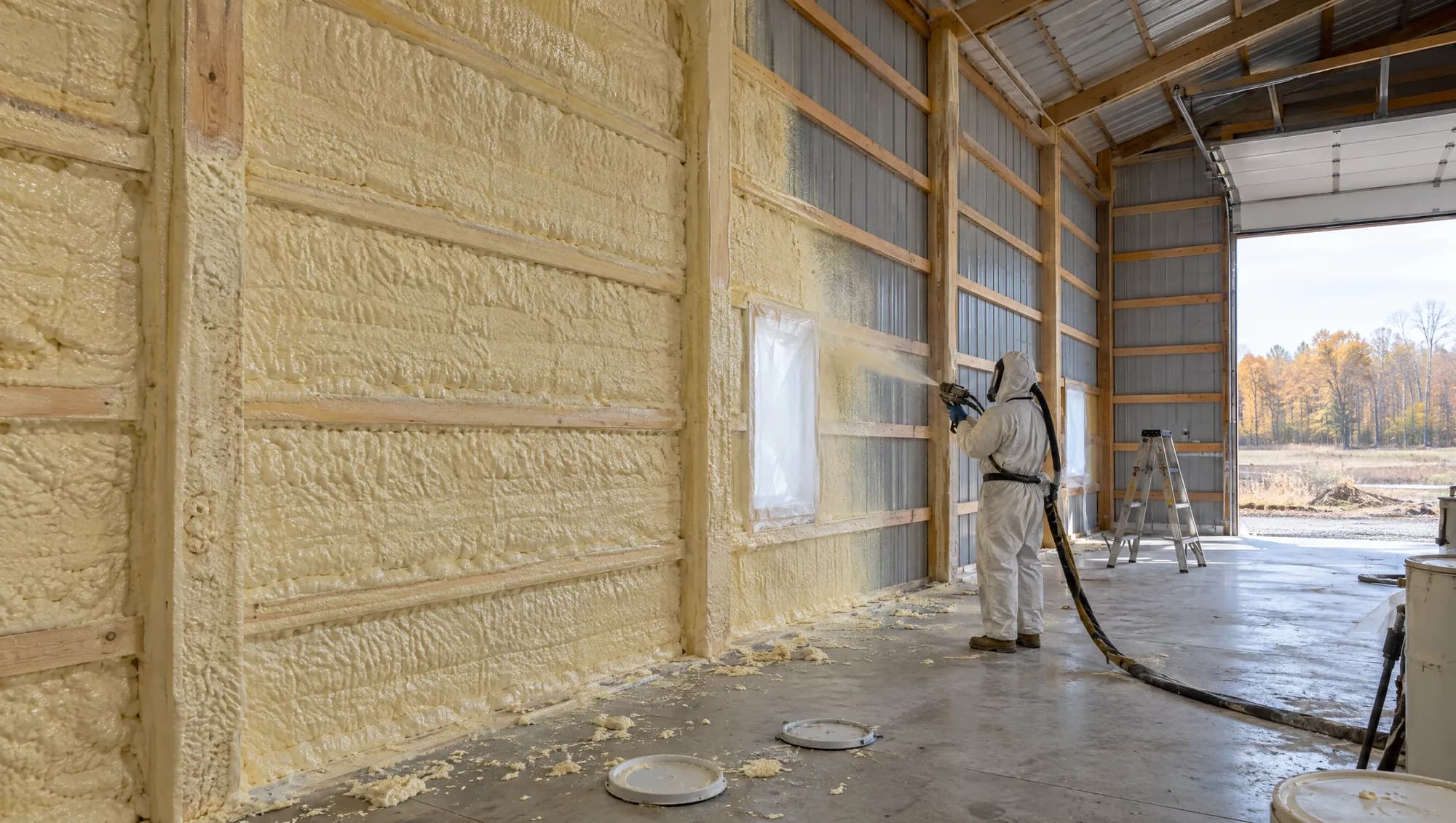
Closed-cell spray foam applied to the steel walls of a post-frame building

Open-cell spray foam

Open-cell foam is soft and spongy, at about half a pound per cubic foot, with roughly R-3.5 to R-3.8 per inch. It expands far more than closed cell, so it completely fills deep wall and roof cavities, and it quiets sound between rooms and floors.

It costs less per inch than closed cell, which makes it a good fit for full-depth wood-framed walls and rooflines. In Minnesota it needs a separate vapor retarder on the warm side, such as a vapor retarder primer or membrane, which we plan for in the estimate.

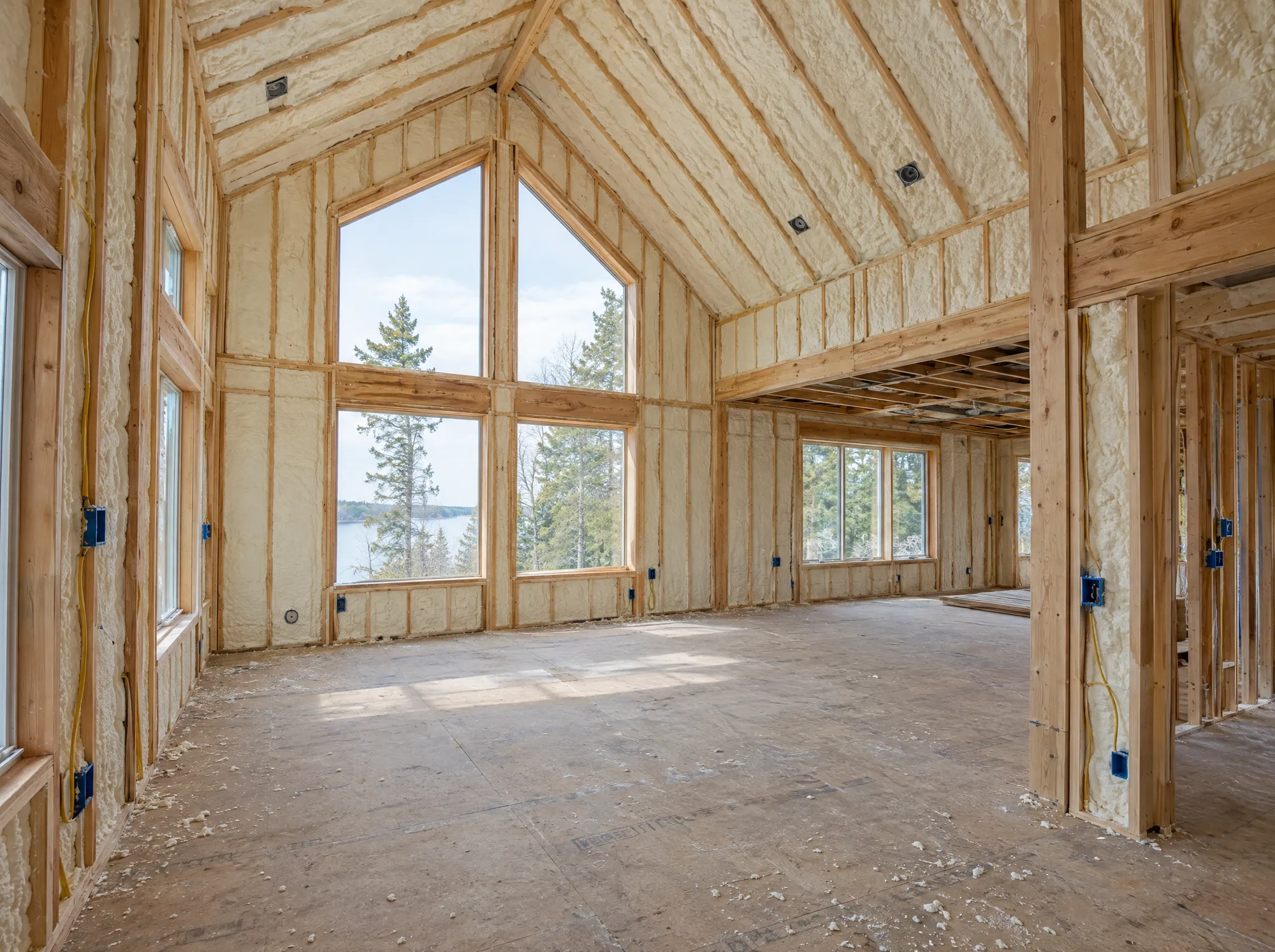
Spray foam trimmed flush with the studs in the walls and vaulted ceiling of a new custom home

Where we spray

Spray foam earns its cost where airtightness, moisture control or limited space matter most. The most common places we spray:

  • Exterior walls in new homes and additions
  • Barndominium and post-frame walls and roofs
  • Pole barns, shops and garages
  • Rim joists and band boards
  • Cathedral and vaulted ceilings
  • Crawl spaces and basement walls
  • Bonus rooms, kneewalls and over-garage floors

Code, safety and cure time

Spray foam is a foam plastic, and the building code treats it that way. In living space it has to be covered by a thermal barrier, usually half-inch drywall. In attics and crawl spaces entered only for service, an ignition barrier or an approved coating can be used instead. We'll tell you which applies before we start.

Our crew sprays in full-face or supplied-air respirators and protective suits. Plan on keeping everyone out of the building while we spray and for the re-occupancy time on the foam manufacturer's data sheet, typically about 24 hours. Once it has cured, the foam is stable and inert.

What to expect on spray day

We mask windows, door openings, outlets and anything that should stay foam-free, then spray in passes to the depth in your estimate. Open-cell foam is trimmed flush with the studs so drywall goes on flat. When we're done we clean up the shavings and overspray and walk the job with you or your builder.

Open cell vs closed cell

Which spray foam does your project need?

Closed-cell foam is dense and rigid, with roughly twice the R-value per inch of open cell, and it doubles as a vapor retarder. It is the right call on steel-sided barndominiums and pole buildings, rim joists, and anywhere space is tight.

Open-cell foam is soft and expands to fill wood-framed walls and rooflines completely. It costs less per inch and quiets sound well, but in Minnesota it needs a separate vapor retarder.

Many new homes use both, or a flash-and-batt hybrid. We’ll recommend what fits each part of your building when we visit.

More about spray foam
Open-cell and closed-cell spray foam compared
PropertyOpen cellClosed cell
R-value per inchAbout 3.5 to 3.8About 6 to 7, depending on the product
DensityAbout 0.5 lb per cubic foot, softAbout 2 lb per cubic foot, rigid
Air barrierYes, at full depthYes
Vapor retarderNo, needs separate vapor control in MinnesotaYes, at about 1 to 2 inches, depending on the product
On steel panelsNot recommended in our climateThe go-to for barndos and pole buildings
Adds strengthNoYes, stiffens walls and roof decks
Best forWood-framed walls and rooflines, sound controlMetal buildings, rim joists, below grade, high-R thin walls

FAQ

Spray foam questions

How thick should spray foam be?

It depends on the foam and the R-value you need. Closed cell at about 2 inches gives roughly R-12 to R-14 and works as a vapor retarder, and about 3 inches reaches roughly R-18 to R-21, depending on the product. Open cell that fills a 2x6 wall (5.5 inches) gives roughly R-19 to R-21. We set the thickness to meet code for your climate zone and how the space will be used.

Is spray foam safe once it cures?

Yes. Cured spray foam is stable and inert. The chemicals are a concern while the foam is being applied, which is why our crew wears respirators and protective suits and why the building needs to be empty during spraying and for the manufacturer's re-occupancy period, typically about 24 hours.

Does spray foam need a vapor barrier in Minnesota?

Closed-cell foam becomes a vapor retarder at around 1 to 2 inches, depending on the product, so it can serve as the wall's vapor retarder when the construction documents call for it. Open-cell foam does: in Minnesota's climate zones it needs a vapor retarder on the warm side, such as a vapor retarder primer or membrane.

Can you spray foam an existing home?

Yes, wherever the framing is open or reachable: rim joists, crawl spaces, attics, bonus rooms and walls opened up during a remodel. For finished walls we usually recommend dense-pack cellulose instead, which goes in through small holes.

Tell us about your project

Building a barndo, a custom home or a shop? Reach out and we'll set up a time to see it. No pressure, no guesswork pricing.